
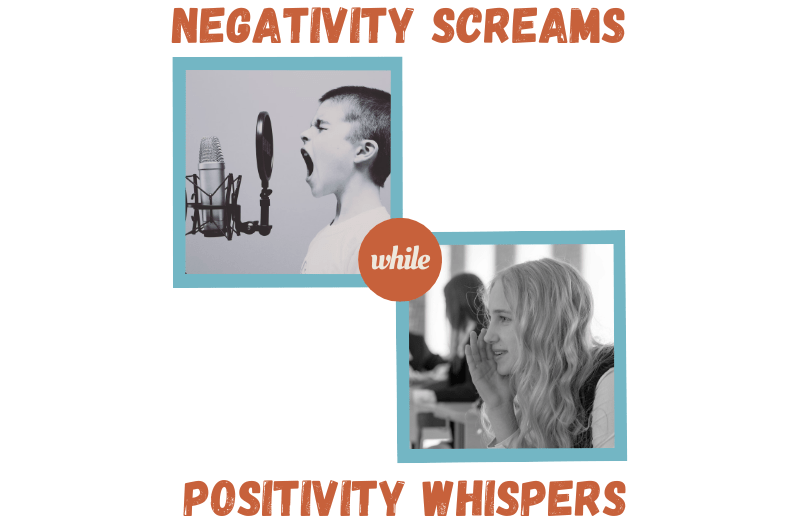
Being good at scanning for threats is a legacy system of our brain. An ancient and reliable system, often overconsuming precious energy 🌀
Read more about our negativity bias and how we can upgrade our brain OS!
Are you taking any steps to train your brain to notice the positives in your life?
Our brains are literally wired to scan for threats. By design, we pay more attention to the threats around us – this is called the “negativity bias” [1]. From an evolutionary perspective, for our ancestors, being good at scanning for threats meant higher chances of survival.
However, when you think of your average day … Most of our moments are positive or neutral, but we don’t notice them. According to research [2], when we look for negative, we only notice negative; and when we look for positive, we are inclined to notice both positive and negative – that’s how strong our negativity bias is!
The good news is we can train our brain! Our brain has neuroplasticity, so we can rewire its neural pathways. Just as we learn a new language, we can train our brain to notice the positives, making us happier ♥ Offsetting the negativity bias takes time and effort, but it’s totally worth it!
So … what to do? Here are some ideas 🙂
- Make a genuine compliment to every person you meet today (live or online)
- Start your team meeting by each sharing something you’re proud of (personal or professional)
- Tell your loved ones what you appreciate most about them
- Daily, write 10 things you’re grateful for (if you’re journaling, you can add it to your journaling practice)
- Plan a “joy moment” every day – cook your favourite cake, talk to a friend, go out for a coffee – you do you 🙂
- Daily, practice being aware of the present moment (e.g.: meditation)

Sources:
[1] NeuroMindfulness® Institute
[2] Cunningham et al., 2018, Affective Flexibility: Evaluative Processing Goals Shape Amygdala Activity
Quote “The negative screams at you but the positive only whispers” by Dr. Barbara Fredrickson, expert in the field of Positive Psychology
 Georgiana Vintila - Mindset Coach ACC