

Have you ever found yourself stuck in a never-ending loop of indecision, unable to grasp the sense of certainty and alignment?
Or have you experienced that moment when a decision just “feels right” and everything clicks into place? No struggle, no second thoughts.
What makes some decisions easier to make than others? And how could we get out of that seemingly never-ending indecision and see from a different perspective what’s actually keeping us from making a choice?
The three brains of our body
TRUST your gut
Listen to your heart
use your head
… does any (or all) of them sound familiar?
Let me introduce you to the most amazing decision-making tool – the human body and its three brains.
Wait, what?! Human beings have more than one brain?
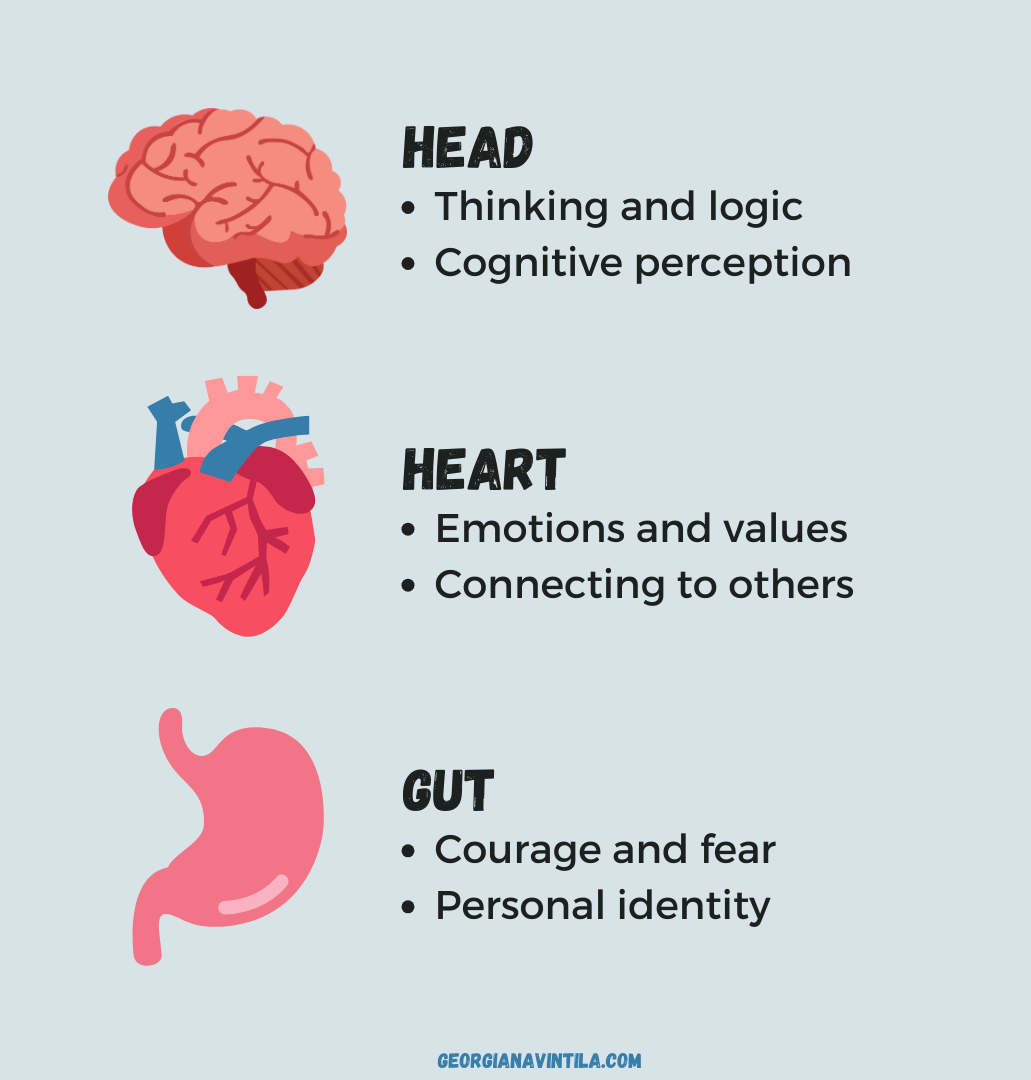
Neuroscience research shows that humans have functional neural networks, or “brains,” not only in their heads, but also in their hearts and guts. Each brain – head, heart, and gut – possesses unique forms of intelligence and serves different purposes. Each has its own prime function in the context of the complex human body [1].
The brain in your head – the Cephalic Brain – unsurprisingly, is very good at cognitive perception, thinking and logic; it is the one making and assigning meaning to what’s happening around us.
The brain in your heart – the Cardiac Brain – is focused on the process of feeling; it’s all about relational affect and connecting with others, values and what is really important to you.
The brain in your gut – the Enteric Brain – represents the personal identity, and gives signs in terms of danger vs. safety; it is also responsible for mobilization, motivation and the courage to act.
Take a moment and think of a tough decision you had to make. How did the process feel?
- Was your head telling you all the logical reasons why it would (not) work?
- Was your heart saying that you didn’t really wanted it anyway?
- Were you feeling butterflies in your stomach, or maybe you were not seeing yourself as someone who could really proceed that way?
When our three brains are aligned, decisions are straight-forward
When you feel a decision is “the right one”, it usually means that your three brains – head, heart, and gut – are aligned. That option makes logical sense for you, there are no tricky emotions about it, and you have the courage to get going.
When you’re stuck in a loop of indecision, there are high chances that “one of your brains is probably trying to talk to you about what it needs to be in place before it gets on board” [2].
The same applies when you set a goal and, after some time, you notice you don’t make any progress. Or when you make a decision, for the sake of deciding, and then you don’t follow through. It’s like a part of you wants to do it, and another part of you is pushing the brake pedal.

How to use the three brains to your advantage?
The very good news is that we can adapt and grow our brains [2]. Just as we know the brain in our head has the property of ‘neuroplasticity’ (this means it can change its structure over time), so can the other brains.
First, acknowledge their existence and accept that each of these brains sends messages to you. Once you are aware of them, you’ll start noticing much easier and faster what they’re saying.
Second, focus intentionally on them when making a decision. Take a few moments, breathe, and connect to them one-by-one [3]:
- What does your HEAD say? What are the logical reasons?
- What does your HEART say? What are the feelings that appear?
- What does your GUT say? What instincts arise?
Third, next time you listen to a friend or colleague explain a situation, try focusing on your three brains by simply bringing your attention to them [3]. You might gain a deeper understanding of what the other person is experiencing, beyond their words.
You can also explore decision-making and the messages of your three brains in a coaching session. If this post sparked your interest, schedule a get-to-know chat with me here.
Have an amazing day!
Georgiana
References and further reading:
- Using your multiple brains to do cool stuff by Grant Soosalu and Marvin Oka, 2014
- Exploring & Expanding Your World: Getting to know all of your Brains by Dr Suzanne Henwood, 2020
- The Discomfort Zone by Marcia Reynolds, 2014
- If you’re looking for more scientific explanations, check out this research paper by Soosalu, Henwood, and Deo, 2019
Cover photo by Caleb Jones on Unsplash
 Georgiana Vintila - Mindset Coach ACC